
July 5, 2026
Romans 12:1–8
“Minds AND Lives”
Overview: Following Jesus is not merely about accumulating religious knowledge, it’s about becoming an entirely new kind of person. God’s purpose for His people is transformation which leads to action. This week will challenge us to move beyond being mere information accumulators to becoming a people whose changed minds lead to changed lives.
Memory Verse for the Week:
1 Peter 2:9 (NIV) “But you are a chosen people, a royal priesthood, a holy nation, God’s special possession, that you may declare the praises of him who called you out of darkness into his wonderful light.”
Background & Miscellaneous Insights:
- This portion introduces a new section of Paul’s epistle emphasizing Christian conduct. He views the entire preceding portion as setting forth God’s great eternal grace and mercy, and appeals on the basis of such divine mercy that obedience should follow. (Rosenius, Romans, 197)
- Paul begins this section of Romans with the Greek work parakaleō [3870] (“I urge you”), the verb form of the noun used for the Holy Spirit, the “Paraclete” (paraklētos [3875]; John 16:7). It carries the idea of standing alongside someone in order to provide counsel, courage, comfort, hope, and positive perspective. (Charles R. Swindoll, Swindoll’s Living Insights, Romans, 306)
- This word transform is the same as transfigure in Matthew 17:2. It has come into our English language as the word metamorphosis. It describes a change from within. The world wants to change your mind, so it exerts pressure from without. But the Holy Spirit changes your mind by releasing power from within. (Warren Wiersbe, Be Right, 122)
- Paul’s use of sacrificial imagery here fits a pattern found throughout the NT. Christians no longer offer literal sacrifices; for Christ has fulfilled and thus brought to an end the OT sacrificial system. But the centrality of sacrifice in ancient religion made it a natural and inevitable vehicle for the early Christians to express their own religious convictions (Douglas Moo, The Epistle to the Romans, 750)
- The church is described in a variety of ways in the New Testament. Perhaps most frequently it is likened to a body; the church is the body of Christ. It is also called the Jaos tou theou, “the people of God.” In every one of those metaphors, the church is made up of people. The church, the ecclesia, in the New Testament is comprised of the “called out ones.” The church is the communion of saints, not a building. (R. C. Sproul, 1 2 Peter, 62)
What kind of church is God seeking to create?
- One marked by wholehearted worship.
(Gen. 22:1-14; Eccl. 12:13; Mic. 6:6-8; Matt. 22:37-38; John 4:23-24; Heb. 13:15-16)
“Present your bodies a living and holy sacrifice.” This is consecration. This is a radical separation from a secular worldview, and it begins with a decision to give our bodies over to a divine purpose. (Charles R. Swindoll, Swindoll’s Living Insights, Romans, 314)
Real worship is the offering of everyday life to God. Real worship is not something which is transacted in a church; real worship is something which sees the whole world as the temple of the living God, and every common deed an act of worship. (William Barclay, Romans, 169)
- One in which people are transformed from the inside out.
(Ezek. 36:25-27; Matt. 23:25-28; John 17:17; 2 Cor. 3:18; Eph. 4:22-24; Titus 3:4-7)
Lives lived in dedication to God should be motivated by what he has done for us in Christ. Otherwise, sanctification, like justification, can become legalistic in orientation. (C. Marvin Pate, Romans, 238)
Consecration in this particular context is a radical separation from a secular worldview to adopt instead a Christlike purpose and way of life. (Charles R. Swindoll, Romans, 306)
- One where every member is valued and engaged in the mission.
(Matt. 28:18-20; John 13:34-35; 1 Cor. 12:12-27; Eph. 2:19-22; 1 Pet. 4:10-11)
Diversity, not uniformity, is the mark of God’s handiwork. (F. F. Bruce, The Epistle of Paul to the Romans, 231)
The body of Christ is harmed whenever its members refuse to accept the part that God has given them to play. (Phillip Graham Ryken, City on a Hill, 83)
It is not wrong for a Christian to recognize gifts in his own life and in the lives of others. What is wrong is the tendency to have a false evaluation of ourselves. Nothing causes more damage in a local church than a believer who overrates himself and tries to perform a ministry that he cannot do. (Warren Wiersbe, Be Right, 123)
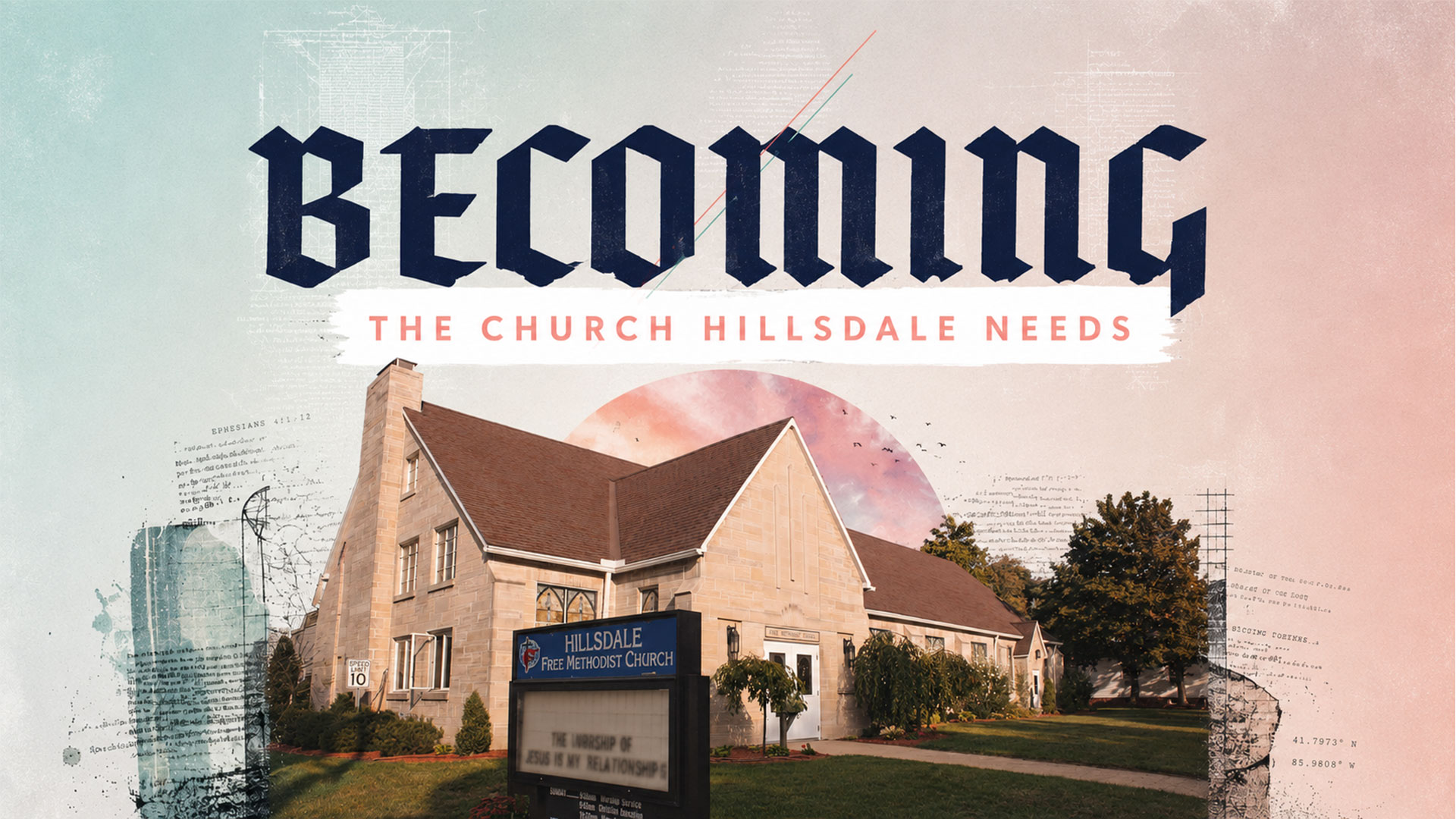
In light of these things, how do we become the church Hillsdale needs?
- By giving God the totality of our lives.
(Deut. 10:12; Josh. 24:15; Luke 9:23-24; John 15:4-5; Gal. 2:20; Col. 3:1-4)
If everything we are and everything we have is a gift of God, then the most appropriate action we can take is to offer all of it back to God. (Bruce E. Shields, Preaching Romans, 134)
The greater our comprehension of what God has done for us, the greater our commitment should be. Practically applied, Christ’s gift, meditated on, accepted, taken to heart, is a magnet drawing us to deepest commitment to him. (R. Kent Hughes, Preaching the Word, Romans, 234)
- By seeking for God to reshape our minds.
(Ps. 119:9-11; Isa. 26:3; John 8:31-32; Rom. 8:5-6; Phil. 4:8-9; Col. 3:2; James 1:22-25)
The Christian life does not mean to stand still, but to move from that which is good to that which is better. (Martin Luther, Commentary on Romans, 167)
No one can be brought to spiritual life without also being fundamentally changed. (R. C. Sproul, 1 2 Peter, 59)
The world wants to control your mind, but God wants to transform your mind (see Eph. 4:17–24; Col. 3:1–11). (Warren Wiersbe, Be Right, 122)
- By giving ourselves to one another.
(John 15:12-13; Acts 4:32-35; Rom. 12:10-13; Gal. 6:2; Phil. 2:1-4; Heb. 10:24-25)
A Christian church is a caring community in which we consider what happens to someone else to be every bit as important as what happens to ourselves. (Phillip Graham Ryken, City on a Hill, 86)
Each member of the Christian Church has a task to do; and it is only when each member contributes the help of his or her own task that the body of the Church functions as it ought to function. (Barclay, Romans, 172)
One of the surest signs that we are really being transformed by the mind of Christ is that we are devoid of the haughty individualism which makes us think more highly of ourselves than we ought. (William M. Greathouse, Beacon Bible Expositions, Vol 6, 178)
Gospel Connection:
Jesus became the perfect sacrifice for our sin so that we could become living sacrifices for His glory.
(Isa. 53:4-6; Matt. 20:28; Rom. 5:6-11; 2 Cor. 5:21; Gal. 2:20; Eph. 5:1-2; 1 Pet. 2:24)
The “imperative” of a transformed life is therefore not an optional “second step” after we embrace the gospel: it is rooted in our initial response to the gospel itself. To eliminate this part of Romans would be therefore to omit an indispensable dimension of the gospel. (Douglas Moo, The Epistle to the Romans, 745)
Spiritual Challenge Questions…
Reflect on these questions during your time with the Lord this week, or discuss with your friends, family, or Life Group.
- When you hear the phrase “living sacrifice,” what do you think Paul is asking us to do? What might that look like in everyday life?
- Romans 12:2 distinguishes between being conformed to the world and being transformed by the renewing of our minds. What are some practical ways our thinking is shaped by our culture, and how can God’s Word reshape it?
- What’s the difference between knowing biblical truth and being transformed by biblical truth? Can you think of an example from your own life?
- Paul says we are “one body” and that “each member belongs to all the others.” How does that challenge the way many people think about church today?
- What are some ways people unintentionally become spectators rather than participants in the life of the church? How can we encourage one another toward greater involvement?
- The gospel tells us that Jesus offered Himself completely for us. How does remembering His sacrifice motivate us to offer ourselves to God and to one another?